



What Is 2 Weeks From Today?

If today is Thursday, May 7, 2026, then 2 weeks from today is Thursday, May 21, 2026.
That’s exactly 14 calendar days from now. Simple enough, right? But here’s the thing — a lot of people trip up on this more than you’d think.
Are you counting today in those 14 days? Are you working with business days or calendar days? Is there a holiday in the middle that might affect your deadline?
Those small details matter — especially when you’re managing a work deadline, a legal notice period, a school assignment, a medical follow-up, or even planning a birthday party.
This guide breaks down everything you need to know about calculating 2 weeks from today, how to use it practically, and what the date actually looks like on a real calendar.
2 Weeks From Today — Quick Answer
| Starting Date | + 14 Days | Result |
|---|---|---|
| Thursday, May 7, 2026 | 14 calendar days | Thursday, May 21, 2026 |
- Day of the week: Thursday
- Business days in 2 weeks: 10 (Mon–Fri, excluding weekends)
- Weekend days included: 4
- Weeks: 2 full calendar weeks
How to Calculate 2 Weeks From Any Date (Step-by-Step)
You don’t need a calculator for this — though one helps when you’re pressed for time.
Here’s the cleanest mental method:
Step 1: Identify today’s date. (May 7, 2026.)
Step 2: Add 14 days to the day number. (7 + 14 = 21.)
Step 3: If the result exceeds the days in the current month, roll over to the next month.
Step 4: Keep the same day of the week. (Thursday + 14 days = Thursday again.)
That last point is the most useful mental shortcut. Two weeks always lands on the same weekday you started. Always. No exceptions.
Started on a Monday? Two weeks later is a Monday. Started on a Saturday? Two weeks out is a Saturday.
This trick alone can save you from staring at a calendar for five minutes.
Also Read: Thank you for the cake message
Calendar View: May 7 → May 21, 2026
Here’s how the 14-day window looks laid out:
| Week | Mon | Tue | Wed | Thu | Fri | Sat | Sun |
|---|---|---|---|---|---|---|---|
| Week 1 | May 4 | May 5 | May 6 | May 7 (Today) | May 8 | May 9 | May 10 |
| Week 2 | May 11 | May 12 | May 13 | May 14 | May 15 | May 16 | May 17 |
| Week 3 | May 18 | May 19 | May 20 | May 21 (Target) | May 22 | May 23 | May 24 |
Clear as a bell. From May 7 to May 21 — no ambiguity.
Business Days vs. Calendar Days: Which One Counts?
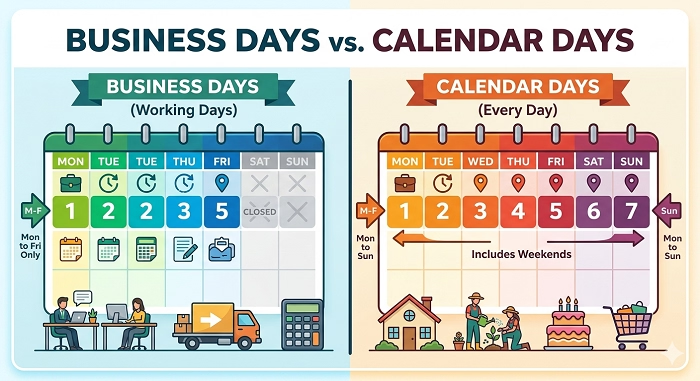
This is where most people get confused, and it’s actually really important depending on your situation.
Calendar days include every single day — Saturdays, Sundays, public holidays, all of it. When someone says “2 weeks from today,” they almost always mean 14 calendar days.
Business days (also called working days) skip weekends and sometimes public holidays. In the 14 calendar days between May 7 and May 21, there are 10 business days.
When does this distinction matter?
- Legal notices: Lease terminations, contract cancellations, and court filings often specify business days. “14 business days” is nearly 3 calendar weeks.
- Bank transfers: International wire transfers quoted as “10 business days” stretch across 2 full calendar weeks.
- HR policies: Notice periods in job contracts are almost always business days.
- Shipping estimates: Courier services typically list transit times in business days.
If you’re using a 2-week timeframe for anything official or contractual — double-check whether the document means calendar or business days. Don’t assume.
Real-World Uses for “2 Weeks From Today”
Two weeks is one of the most commonly used time spans in daily life. Here’s where it shows up constantly:
1. Job Resignation Notice
The standard “two weeks’ notice” is a professional courtesy that’s been around forever. It gives your employer time to start the hiring process, and it protects your reputation.
If you hand in your resignation today (May 7), your last working day would typically be May 21, 2026 — assuming a standard Monday–Friday schedule and no holidays falling in that window.
Worth noting: some companies calculate your notice in calendar days, others in business days. Check your employment contract.
2. Medical Appointments and Follow-Ups
Doctors commonly schedule follow-up visits at the 2-week mark — especially after surgeries, new prescriptions, or lab work. If your doctor says “come back in two weeks,” that’s May 21.
Set a reminder the moment you leave the office. Two weeks feels long, but it sneaks up fast.
3. Event and Party Planning
Two weeks is the sweet spot for many event preparations. It’s enough time to:
- Send invitations and get RSVPs
- Book a venue for a smaller gathering
- Order a custom cake or catered food
- Confirm guest lists and dietary needs
If you’re planning something for May 21, today (May 7) is actually the ideal day to start.
4. Academic Deadlines
Professors often assign papers or projects with a 2-week window. Knowing the exact date helps you build a backward schedule:
- Day 1–3 (May 7–9): Research and outline
- Day 4–7 (May 10–13): First draft
- Day 8–11 (May 14–17): Revisions and edits
- Day 12–13 (May 18–19): Final polish
- Day 14 (May 20): Submit one day early as a buffer
That one-day buffer is something most students skip — and then regret.
5. Financial and Billing Cycles
Payroll, invoice due dates, subscription renewals — a lot of financial cycles run on 2-week or biweekly schedules. If a payment is due “in two weeks,” it’s due May 21, 2026.
Track it. A missed payment — even by a day — can trigger late fees or affect your credit score.
Also Read: Thank you message for my dog who passed away
What Holidays Fall in the Next 2 Weeks? (May 7–21, 2026)
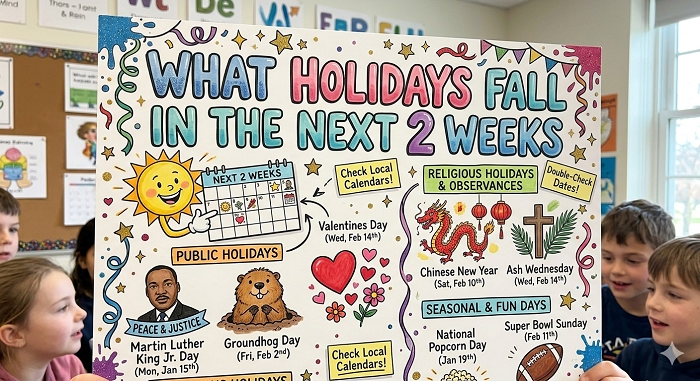
This matters more than people realize when calculating deadlines.
| Date | Holiday / Observance | Country/Region |
|---|---|---|
| May 10 | Mother’s Day | USA, Canada, Australia, and others |
| May 18 | Victoria Day | Canada |
| May 21 | Various regional holidays | Check local calendars |
If you’re in the UK, Canada, or another country with bank holidays in mid-to-late May, double-check before committing to a business-day deadline.
Mother’s Day (May 10) is worth a special mention for anyone planning gifts, restaurant bookings, or family events — because it’s only 3 days away.
How to Add 2 Weeks to Any Custom Date (Not Just Today)
Sometimes you need to calculate forward from a date that’s not today. Here’s the fastest approach:
Option 1 — Mental math:
Add 14 to the day number. If it exceeds the month’s total days, subtract the month’s length and roll to the next month.
Example: 2 weeks from January 25 = 25 + 14 = 39. January has 31 days. 39 − 31 = February 8.
Option 2 — Same-weekday rule:
Just count forward two rows on any calendar. Since weeks are always 7 days, moving down two rows in a monthly calendar always gives you exactly 14 days.
Option 3 — Use a date calculator:
Tools like timeanddate.com or calculator.net let you plug in any start date and add exactly 14 days. Fast and foolproof for important deadlines.
Common Mistakes When Counting 2 Weeks
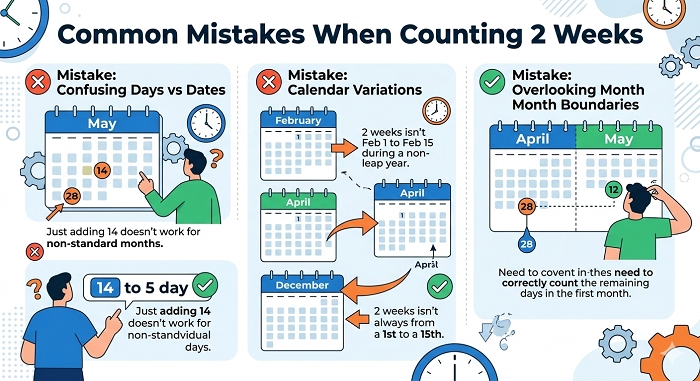
These trip people up more than they should:
Counting today as “Day 1.”
If today is May 7 and you count it as Day 1, you’ll land on May 20 — one day short. The correct method: today is Day 0, and Day 14 is two weeks later.
Forgetting month-end rollovers.
People counting “2 weeks from May 25” sometimes panic about crossing into June. Just add 14 — it’s June 8. Months don’t reset your counting logic.
Mixing up “2 weeks” and “the week after next.”
These aren’t the same thing. “The week after next” could refer to as few as 8 days away or as many as 14, depending on when you’re speaking. “2 weeks from today” is always exactly 14 days.
Ignoring time zones for digital deadlines.
If your deadline is online — a form submission, an exam portal, a bid closing — check which time zone the deadline is in. Midnight on May 21 in New York is already May 22 in London.
Countdown: Days, Hours, and Minutes Until May 21, 2026
As of today, May 7, 2026:
- 14 days remaining
- 336 hours remaining
- 20,160 minutes remaining
- 10 business days (excluding weekends)
If you’re working on a project with this deadline, you’re not as far away as two weeks might feel. Start today.
Frequently Asked Questions For 2 Weeks From Today
Q: What is the exact date 2 weeks from today?
A: As of May 7, 2026, two weeks from today is Thursday, May 21, 2026.
Q: Is 2 weeks the same as 14 days?
A: Yes, always. One week = 7 days, so two weeks = 14 days, no exceptions.
Q: How do I quickly calculate 2 weeks from any date?
A: Add 14 to the day number of your starting date. If it overflows the month, subtract the month’s total days and roll to the next month. The resulting day of the week will always match your start day.
Q: Does “2 weeks’ notice” at a job mean 14 calendar days or 10 business days?
A: Standard two weeks’ notice typically means 14 calendar days, but always check your employment contract — some employers count business days only.
Q: What if a holiday falls within my 2-week countdown?
A: For calendar-day deadlines, holidays don’t change the count — it’s still 14 days. For business-day deadlines, public holidays may add extra days to your timeline.
Q: What day of the week will 2 weeks from today be?
A: Since 14 days is exactly 2 full weeks, it always lands on the same day of the week as your start date. If today is Thursday, so is the date 2 weeks from now.
Final Thoughts
Two weeks sounds like a lot. It rarely is.
Whether you’re counting down to an event, managing a work deadline, waiting on a medical result, or planning a move — knowing the exact date matters. And now you know it: 2 weeks from today (May 7, 2026) is Thursday, May 21, 2026.
More than that, you’ve got the tools to calculate it instantly for any date, avoid the most common counting mistakes, and apply it correctly whether you’re dealing with calendar days or business days.
Mark May 21 on your calendar now. Build backward from it. Give yourself a buffer. Two weeks passes faster than you think — and the people who plan ahead are always the ones who show up ready.
